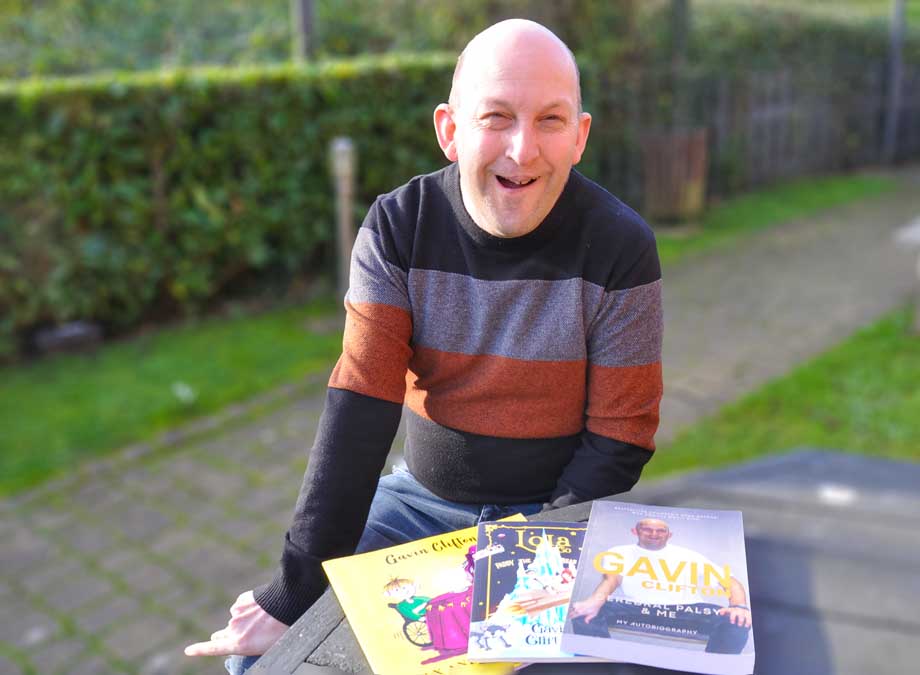
Gavin Clifton is a UK-based children’s author, inspirational speaker, disability advocate and lyricist. Known professionally as The Disabled Writer, Gavin was born with cerebral palsy and a severe speech impairment.
I had no professional support since I left comprehensive school.
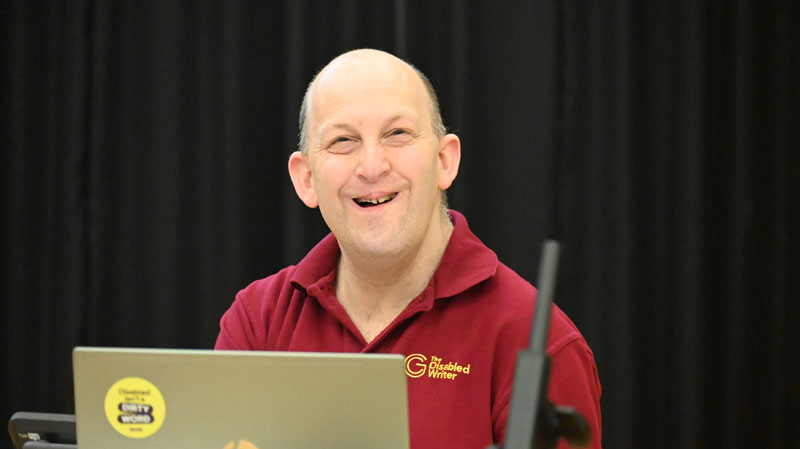
Let that sink in for a little while. Pride didn’t begin for me at some representative parade, but when someone finally told me I was allowed to ask what I needed.
When I worked at the newspaper, my colleagues were brilliant. I had more support from them than I ever got from any official system or scheme. But the building itself had a different story. I eventually got an accessible parking space, but other employees regularly used it, so I'd arrive for work and find myself parked in a non-accessible space. There were no ramps and no automatic doors. For some reason, there was no accessible toilet inside the office. The only one was in the customer reception area, which meant every time I needed the toilet, I had to go back through a security door, down a step, and through queues of clients. I was an employee who worked long hours there. Not an occasional visitor. I also couldn’t use the telephone at all, and I used to get blisters on my wrists from typing all day. That was people being decent, not a formal support package. Looking back, I should have pushed for one. I was reluctant to ask. My stubbornness got the better of me. I thought asking for adjustments would make me look like I couldn’t manage. So, I said nothing and got on with it. Then, some years later, I went self-employed, and there was nothing. No support worker, no signposting, no one sitting me down and asking what I needed. Just me, figuring it out on my own.
That's what you do when no one tells you there's another option.
After I was made redundant, I began writing Max and the Magic Wish. I’d spent most of my adult life refusing to accept my disabilities, I still do occasionally. But working on the book, seeing myself become a character, crying when I first saw the illustrations, that’s when something deeper started to ignite. I describe it in my autobiography as the start of an open-road journey toward accepting myself as a disabled adult and falling in love with who I am.
I’m still on that road. But I know where I’m going now.
Jamie is a motivational speaker and adaptive athlete, the kind of person whose energy gets into the room before he does. He asked me a simple question: What support was I getting as a disabled self-employed person?
Back when he directly asked me this question on the spot. I couldn’t answer him because no one had told me what kind of support existed. I literally assumed that I wasn’t entitled to support when I transitioned to a self-publishing, self-employed author and writer, and inspirational speaker using AI-Voice.
He asked if I'd heard of the Access to Work scheme. I hadn't. Not properly anyway. When he explained it, I felt two things at once: relieved and angry. Because this scheme had been sitting there, open to people like me, and in all those years, nobody had ever mentioned it. Not once.
I'd spent years blaming myself for not being independent enough. For needing too much. For not managing things better. The truth was that I was never the problem. I wasn’t provided the appropriate support.
That's when the realisation finally sank in. During a conversation where someone finally said. This exists, and you’re allowed to ask for it.
That was only part of the journey. Learning to ask for help and learning to accept yourself aren’t the same thing. I’d spent most of my adult life refusing to accept my disabilities, and there are still days when I still do. Even after things started improving, even after I’d got support in place. The real progression came later.
Working on Max and the Magic Wish, seeing myself become a character, crying when I first saw the illustrations. I describe it in my autobiography as the start of an open road journey to accepting myself as a disabled adult and falling in love with who I am.
I’m still on that road. But I know where I’m going now.
The Disability Pride Flag was designed by Ann Magill. A writer with cerebral palsy.
Her original design featured bright zigzagging stripes on a black background, the zigzag representing the barriers disabled people face. But the design itself caused visual disturbance for some people in the community she was designing it for.
So, the community flagged it. She listened, went back to it, straightened the stripes, and muted the colours. Then she waived her copyright so anyone could use it.
A disabled creative makes something, gets some of it wrong, the community helps fix it, and the result belongs to everyone.
Here’s what each part of the current flag represents:
Charcoal grey background: Mourning and rage for disabled people lost to ableist violence, abuse, and neglect
Red: Physical disabilities, including mobility impairments, limb differences, and chronic pain
Pale gold: Cognitive and intellectual disabilities
Pale grey: Invisible and undiagnosed disabilities
Light blue: Psychiatric disabilities, including anxiety and depression
Green: Sensory disabilities, including blindness and deafness
The diagonal stripes aren't just a design choice. They represent cutting across the barriers that keep disabled people apart from the rest of society. Not going around them, but through them.
I’ve had parents tell me they’ve been searching for a children’s book like Max and the Magic Wish. A book where a disabled child is just the main character. Not a lesson or a source of inspiration for everyone else. Just a child who happens to have a disability, getting on with life.
Max doesn’t wish his disability away. Disability is part of who he is, and that’s fine. That’s the whole point.
A disabled child who sees themselves in a story gets something really important from that. They see that it’s okay to be different, and when a non-disabled child who reads about a disabled character just getting on with their lives learns something that stays with them for a long time. That’s how we educate others and make a difference along the way.
Cerebral Palsy and Me is for adults. The parents who want to understand what their child might be going through. The people who’ve lived with a disability their whole lives and just want to see their experience written down honestly. It’s unfiltered and open, and it doesn’t pretend everything is straightforward. Because it isn’t always. But it is always worth it. Like i say in Cerebral Palsy and Me: Life is a rollercoaster journey.
Together, the two books cover both ends of the same journey. One for the child just starting out. One for the adult who is still navigating life. If this month is about the world working better with us in it, that starts with us being seen. In boardrooms, yes. In schools, yes. But first, in books.
On Monday, 20th July, I’m doing a book reading and signing at Cardiff Central Library, in association with Scope. Free entry, 12 noon to 4 pm.
I'll be reading excerpts from both Max and the Magic Wish and Cerebral Palsy and Me. Both books will be available to buy and get signed on the day. Cardiff Libraries will also be stocking both titles from that date onwards, so if you can't make it, they'll be there.
This one is for:
• Families with children who don't often see themselves in books
• Teachers and librarians looking for titles that actually do the work
• Anyone in the disability community who fancies an afternoon out
• People who've never picked up a book about disability and are curious
Disability Pride Month works best when it produces something authentic. A conversation, a book on a shelf, a child who reads something and thinks, that's me.
I had no professional support from the time I left primary school. For a long time, I thought that was just how it was.
It wasn't, and if nobody's told you that yet, this is me telling you. You’re never alone.