It’s Not a Workaround. It’s How I Communicate Differently
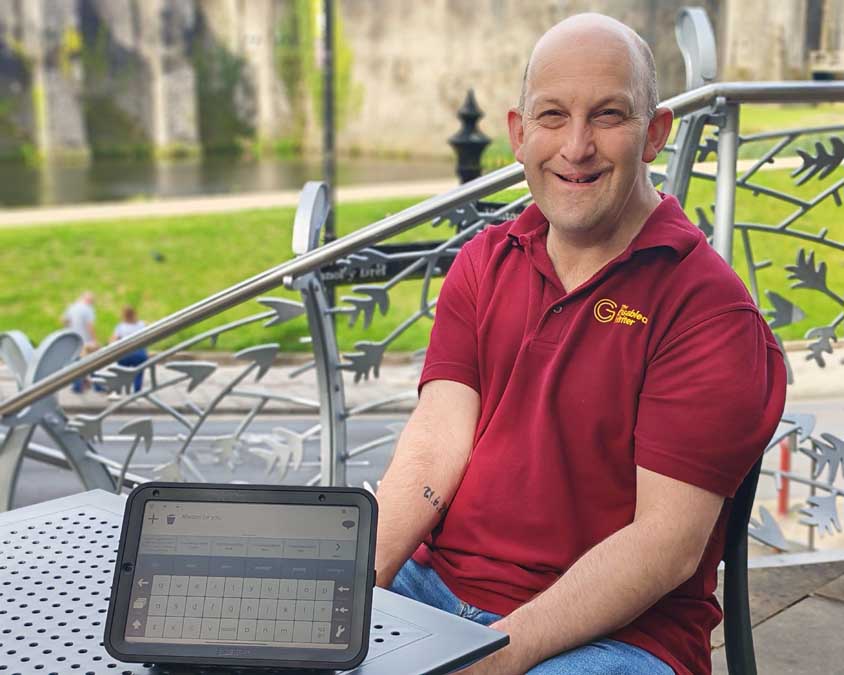
More often than not, my TalkPad starts with a witty one-liner. It breaks the ice, and people never know what to expect when I pull out my TalkPad. A one-liner in my AI voice tends to sort that out quickly. I sound Welsh in my head. The voice doesn’t sound quite like me, but I am okay with that, because the joke is still authentically mine.
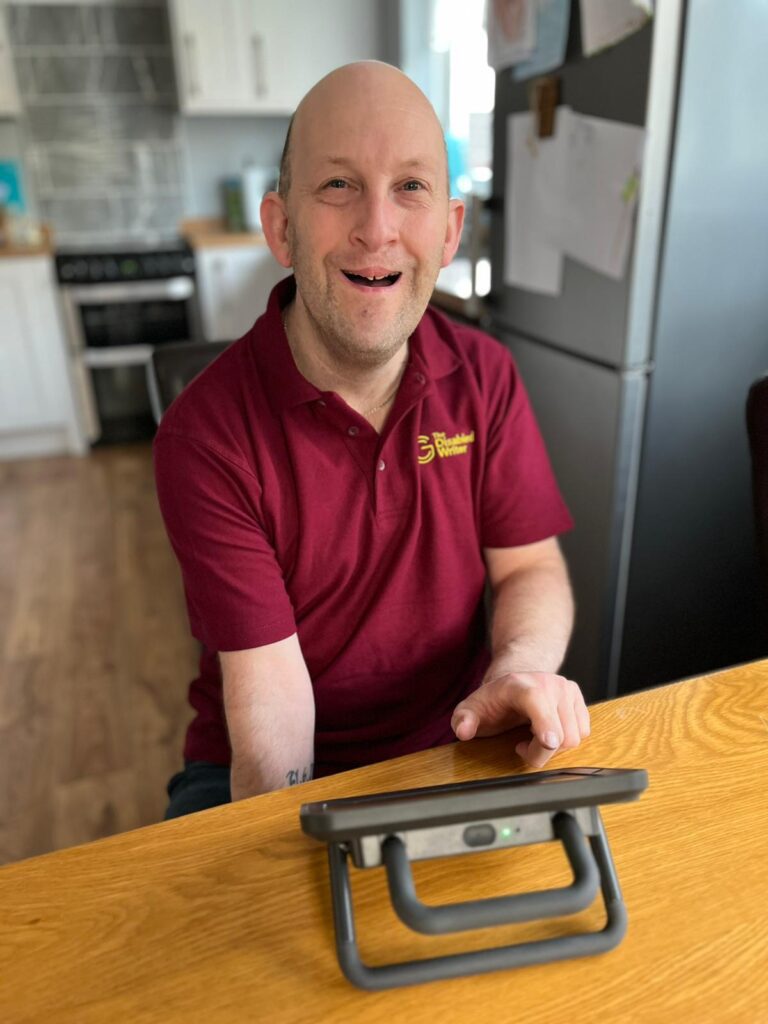
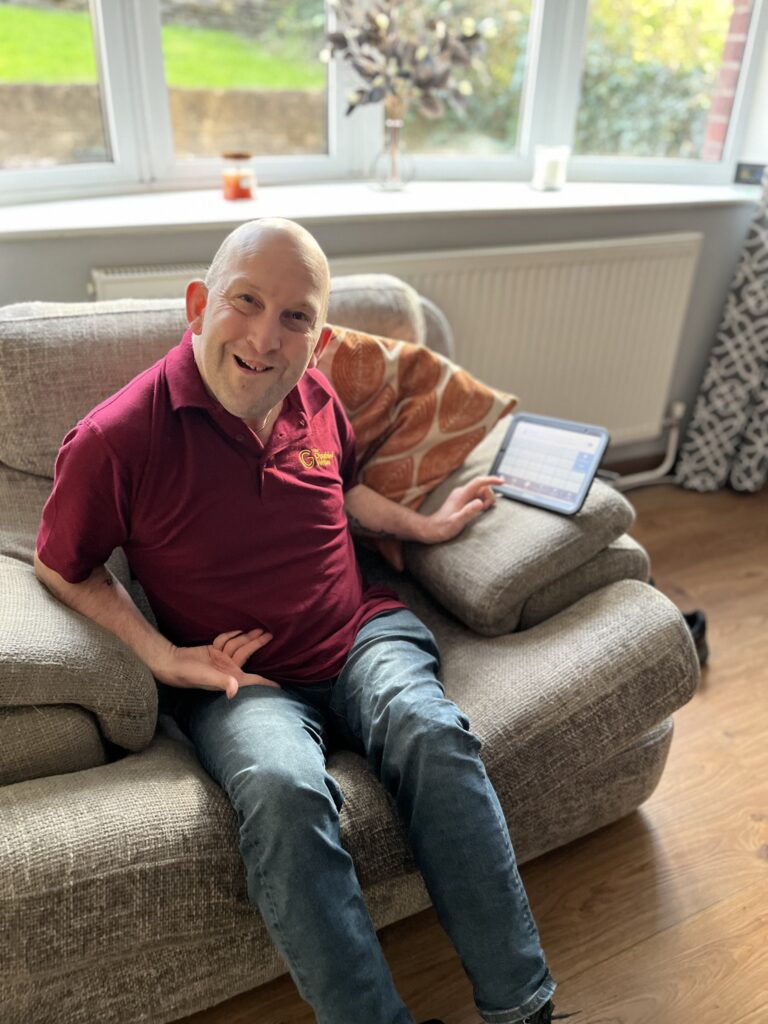
My relationship with AAC started in my last year of junior school, and for a long time it was love-hate. My first device was a Lightwriter, and the keys were so stiff that pressing them felt like a workout, and I had to haul the bulky device everywhere. These days I use a TalkPad 8, a tablet, which is a lot easier to live with. I’m turning love-hate into love-love. I’m getting there.
Some of that is down to what it lets me do on my own. The things I usually need to say at the post office or grocery store are saved as quick answers on my TalkPad, so they are ready before I reach the counter assistant. My answers for TV, radio and podcast interviews are recorded in advance. So are my introductions at networking events and my inspirational and author talks, so none of it relies on someone else speaking for me.
That last part matters more than it sounds. Not long after my first book came out, I went on an American podcast without telling the host about my speech impairment. They said hello, I said hello back, and their face went blank. My publisher at the time was on the call and ended up doing all the talking for an hour about my book, while I sat there. I haven’t let that happen since. I don’t go anywhere without my TalkPad and laptop now, and when I’m on a show or on stage for an inspirational talk, the words are mine.
It’s October, which means it’s AAC Awareness Month, which means there are a lot of posts explaining what AAC actually is. Augmentative and alternative communication: letter boards, symbols, sign language, apps, devices, pointing, even facial expressions. That’s all useful. But I think people get one thing wrong. They see someone using AAC and assume they are watching a workaround, the second-best option for someone who can’t communicate as effectively as they’d like to. It’s not. It’s an accessible tool and how I get to communicate for myself.
The other thing people misunderstand is that the device only does half the job. The other half is being patient when listening. When I met a Member of the Senedd to talk about getting Max and the Magic Wish into Welsh schools, I played her a response I'd recorded on my communication aid. She listened to every word. No glancing at whoever was with me, no hurrying it along. It was a good meeting, and a lot of that was down to her. Years before that, the lady who became my first publisher met me outside a local pub. Yes, I know what you’re thinking. It wasn’t the most conventional way to meet a book publisher, but that’s truthfully where I met them. My mum came along in case the publisher couldn't understand me. We chatted for a while. A few days later, I found myself stepping onto a journey to becoming a published author.
It isn't all smooth. My friends reckon they understand my actual speech better after I've had a drink. Most people slur. Apparently, I get clearer. I'm still working out whether that's a breakthrough or a problem.
But the good conversations far outnumber the bad ones, and they have something in common. The person on the other side isn't doing me a favour. They're just waiting for me to finish, the same as they would for anyone.
The voice doesn't sound like me. When someone waits for the whole sentence, they still hear me.
From Fighting It to Finding My Voice with AAC
October was AAC Awareness Month. Augmented and Alternative Communication (AAC) refers to any tool or method that supports or replaces spoken language for people who have difficulties with speech. This can range from simple approaches like gestures, signs, and picture boards to more advanced technology like speech-generating devices, eyegaze systems, and text-to-speech software. It allows people to communicate in a way that works for them, on their own terms. I’ve always had mixed feelings about using AAC. It’s never been smooth or simple. At times, I hated it. It was bulky, slow, and frustrating. I spent years trying to avoid it, relying on people around me to speak for me. But deep down, I knew that wasn’t real independence.
This month changed things. Speaking at Cardiff Met – The Power of Lived Experience
I was invited to give a talk at Cardiff Metropolitan University by Katherine Broomfield, a Senior Research Fellow and Speech and Language Therapist, and Ria Bayliss, Programme Director, Bsc (Hons) in Speech and Language Therapy, as part of their Interprofessional Education Training and AAC Group. I spoke about my life with cerebral palsy, my experiences with communication, and how AAC has shaped my journey, the good and the bad. The students were brilliant. Open-minded, respectful, and genuinely interested. Their feedback? It’s been some of the best I’ve had. They didn’t just listen, they embraced it with enthusiasm. They understood what it means to communicate differently, and how much that matters in practice. That sort of response makes a difference.
Smartbox – Giving AAC a Real Purpose
Later in the month, I visited the Smartbox Assistive Technology team in Bristol, one of the leading companies in the AAC field. They’re the people behind Grid 3, the software I use. Grid 3 is a communication tool that supports people who can’t rely on speech. It’s fully customisable and works with different access methods, eyegaze, switches, or touch. It helps people express themselves clearly, whether that’s through pre-set phrases, full conversations, social media, emails, or presentations. During the visit, we looked at how I use Grid 3 now and how to tweak it so it actually works for me, not against me. I was treated like a professional wanting to improve how I communicate. It was so refreshing to visit such a forward-thinking company that gets how it feels to want to be able to communicate more effectively in today’s ever-growing and fast-paced society. That felt powerful. Properly empowering, in fact.
A Shift in Thinking
I’ve come a long way since the early days of bulky Lightwriters and feeling like an afterthought in conversations. These days, my device gives me control. I choose when and how I speak. I can hold the room. That matters, especially when you’ve spent most of your life being spoken over, ignored, or having people make assumptions before they even get to know you. Let’s be clear, AAC doesn’t make life easy. But it makes life possible. It’s not a luxury. It’s not an extra. It’s how I get my voice out, in my way, on my terms.
Where I Stand Now
I’m beginning to develop a genuine appreciation for AAC, as I continue to see how effectively it supports me in expressing myself clearly and independently. If you use AAC, or support someone who does, know this: it’s okay to feel frustrated by it sometimes. It’s okay to want to throw it all out the window. But it’s also okay to come back to it, to find your way with it, and to say, “This is how I speak.”
This AAC Awareness Month reminded me that communicating differently doesn’t lessen my voice; it strengthens it. However, when I speak, it’s still me being heard. That’s what truly matters.
Here are links for Cardiff Metropolitan University Centre for Speech, Hearing and Communication Research and SmartBox Assistive Technology if you wish to explore AAC further:-
Different Voices, Same Message: Why Embracing AAC is Key to a More Understanding Future
Communication is a fundamental part of human interaction. It’s how we express our thoughts, share our experiences, and connect with others. For most people, speech is the primary means of communication, but for those with disabilities affecting their speech, alternative methods are crucial. This is where Augmented and Alternative Communication (AAC) comes in. It is a tool that bridges the gap and challenges us to see the world from a different perspective.
Embracing AAC is not just about providing a voice to those who communicate differently; it's about understanding that every voice has value, regardless of how it is expressed.
What is AAC?
AAC refers to various tools and strategies that help individuals with speech or language impairments communicate. This can include anything from simple gestures and picture boards to sophisticated electronic devices that generate speech. AAC aims to give individuals a way to express themselves that works best for their abilities, making communication accessible to everyone.
AAC isn't a one-size-fits-all solution; it's a personalised empowerment tool. Whether a child learns to use picture cards to communicate their needs or an adult uses a high-tech device to convey their thoughts, AAC empowers people to take part in conversations they might otherwise be excluded from, inspiring them to reach their full potential.
The Power of Diverse Communication
One of the most powerful aspects of AAC is that it highlights the fact that communication goes beyond words. Different methods are used to express ideas through symbols, technology, or gestures. AAC users remind us that the essence of communication is connection, not the method used.
In a world that often prioritises verbal speech, we need to broaden our understanding of what it means to communicate. Embracing AAC allows us to see the value in diverse communication styles and challenges the stigma surrounding non-verbal speaking. It encourages us to focus on the message rather than the method, leading to more profound empathy and inclusivity.
Breaking Down Barriers with AAC
Traditional communication barriers can be isolating for individuals with disabilities. AAC tools can help break down these barriers, making it easier for people to engage in social, educational, and professional settings. When someone uses AAC, they are not just communicating; they are participating, sharing, and contributing to conversations in ways that might not have been possible otherwise, offering a hopeful vision of a more inclusive future.
For example, in classrooms, AAC can be a game-changer. It allows students who cannot speak to actively participate in discussions, answer questions, and share their thoughts with their peers. In the workplace, AAC enables employees with speech impairments to collaborate with colleagues, contribute ideas in meetings, and express their talents fully. In each scenario, AAC acts as a bridge, connecting people who might otherwise be left out.
Challenging Misconceptions
Despite its benefits, AAC is often misunderstood. Some people mistakenly believe that AAC is a last resort, used only when all other communication methods fail. AAC can be the first choice for many individuals, offering them a reliable way to communicate their thoughts and emotions without struggle or frustration.
Another common misconception is that using AAC means a person lacks intelligence or understanding. This couldn't be further from the truth. AAC users are just as capable of complex thought, humour, and creativity as anyone else; they express themselves differently. By embracing AAC, we acknowledge that intelligence and insight are not limited to spoken words but can be beautifully conveyed in various forms.
Embracing AAC in Everyday Interactions
How we respond to someone using AAC can make a world of difference. It’s crucial to approach these interactions with patience, respect, and an open mind. Here are a few simple ways to embrace AAC in your everyday life:
Be Patient: Give the person time to communicate without rushing them. It might take longer for someone using AAC to formulate their response, but their message is worth the wait.
Focus on the Message: Pay attention to what the person is trying to say, not the method they are using to say it. Acknowledge their message with the same respect and consideration you would give to any verbal communication.
Engage Directly: Speak directly to the AAC user, not just their personal assistant or companion. This shows respect and acknowledges their autonomy in the conversation.
Ask Questions: If you don’t understand something, don’t be afraid to ask for clarification. Most AAC users appreciate when people try to understand them rather than make assumptions.
My AAC Struggles
As someone in my 40s who has used AAC on and off over the years, I've had a love-hate relationship with it. Still, nowadays, I find AAC helpful when doing interviews or asking for something in a shop. I can pre-record what I want to say. However, I still find it hard to use AAC in everyday conversations. It's not in real-time, so by the time I've typed in what I want to say, that part of the conversation has finished and moved onto another subject before I can contribute to the discussion.
Despite the profound challenges, whilst those early methods of using AAC didn’t work for me, I have been drawn back to using it only to find out it has evolved in some ways. Today, AAC tools have advanced significantly, incorporating predictive text, voice recognition, and other features that better support the needs of my communication today.
Why AAC Matters for a More Inclusive Society
At its core, embracing AAC is about embracing diversity in all its forms. It’s a step towards a more inclusive society where everyone can express themselves, regardless of how they communicate. By accepting and valuing different voices, we create a culture prioritising understanding over judgment.
When we accept AAC as a valid and powerful communication, we communicate that everyone’s thoughts and ideas matter. We open the door to richer conversations, greater empathy, and stronger connections that cross language boundaries.
My AAC Advocacy
I hope that by sharing my experiences, I can help others learn to love AAC and never feel embarrassed about using communication devices in public. I know firsthand how frustrating it can be, but it can give you a voice. I'm still learning about AAC, but I'm now trying to use it to educate others that AAC can be more than just a communication tool. It can fuel dreams and elevate potential. I'm trying to show others what disabled people can do. We need to break down the barriers around AAC, and I hope my advocacy can inspire others to join this vital mission.
There are many ways we can advocate for AAC. We can promote success stories that make a difference, helping to spark conversations about accessibility, inclusion, understanding, and acceptance. I hope this message gives you hope. I now want to use my story to educate others and show them that AAC can be an excellent communication method.
My AAC journey is far from over, but it's already taken me further than I ever imagined. I'm excited to see how AAC continues to evolve, and I'm committed to using my voice to advocate for its potential to empower others. The future of communication is accessible, inclusive, and full of possibilities. Let's embrace it together.
Do you have a story to share about AAC? Are you working on a project related to communication accessibility? I'd love to hear from you! Contact me to collaborate or share your experiences.